D3PLOT2HDF5
Converts LS-DYNA d3plot files to HDF5, with XDMF files for ParaView, VisIt and EnSight.
- d3plot in
- HDF5 + XDMF out
- Solid, shell, beam elements
- EM multi-solver data
- Linux, macOS, Windows
Free for non-commercial use · commercial license on request
Gallery
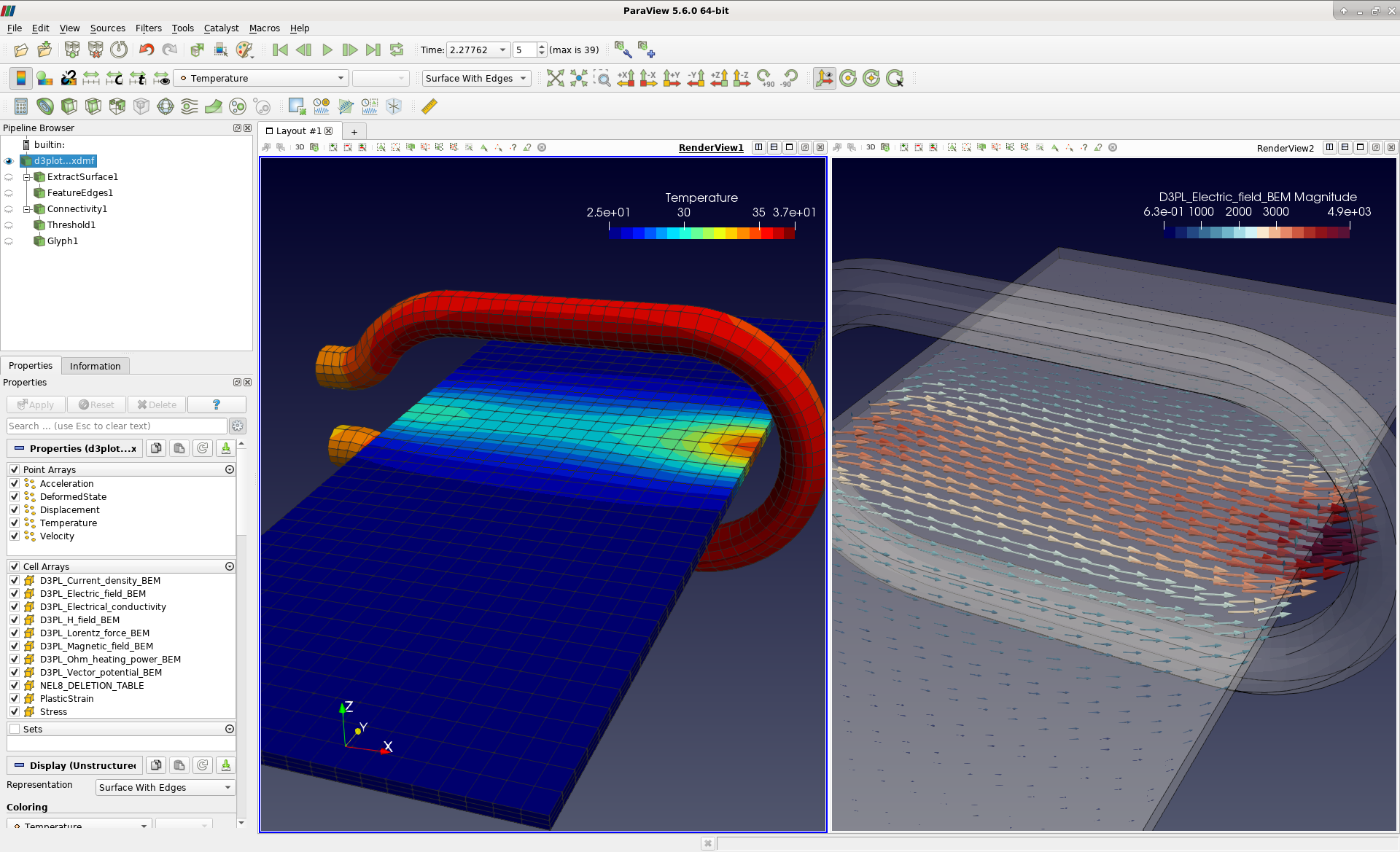
Examples post-processed in ParaView through the XDMF files. Click an image to enlarge it.
Most models are taken from the LS-DYNA examples page.
About D3PLOT2HDF5
D3PLOT2HDF5 converts LS-DYNA's d3plot binary files to HDF5. It is free for non-commercial use.
d3plot files are usually read with LS-PrePost or with commercial third-party tools such as Oasys D3PLOT. A freely available alternative from qd-eng offers a Python API and can also export d3plot contents to HDF5.
Our aim is a fast, secure and lossless conversion. Thanks to its BSD-like license, HDF5 fits into commercial and non-commercial applications alike, so you can build your own post-processing on top of D3PLOT2HDF5.
D3PLOT2HDF5 also writes an XDMF file that references the HDF5 data. ParaView and VisIt, as well as EnSight, open it directly.
Features
Input
Single- and double-precision d3plot files.
Elements
Volume, shell and beam elements.
Nodal fields
Temperature, displacements, velocities and accelerations.
Electromagnetics
Data from the LS-DYNA EM multi-solver.
Integration points
Element-wise average, minimum and maximum of fields defined at integration points.
Your own analysis
HDF5 data you can process in MATLAB, Mathematica and other tools.
Command line
A single command-line tool for Linux, macOS and Windows.
Known limitations
- d3plot files are always read as little-endian.
- Thick shell elements are not tested and will likely fail.
- Multi-solver data other than EM is not supported yet.
- Extra data sets, such as higher-order mesh data, are not supported yet.
Missing a feature or stuck? Contact us or post in the forum.
Download
Latest version for every supported platform. Build details are in manifest/release.json inside the archive.
| Platform | Package | Verification |
|---|---|---|
| Linux x86_64 | Download tar.gz | checksum signature |
| macOS, Apple silicon | Download tar.gz | checksum signature |
| Windows 11 x86_64 | Download zip |
Linux
Built on AlmaLinux 8.10. Any Linux system with glibc 2.28 or newer should work.
macOS
Requires macOS Sequoia or newer on Apple silicon. If you downloaded the package with a web browser, remove the quarantine flag:
xattr -d com.apple.quarantine <package>Windows
Windows 11 on x86_64. The download is a ZIP file; the executable is properly signed.
Verify the download
Linux and macOS packages come with a SHA-256 checksum and a GPG signature of it. Download both next to the package and run the two commands: the first checks the signature with our public GPG key, the second checks the package against the checksum.
Primary key fingerprintDFD5 ED95 92B8 B3AC 7A8D AC72 C5E5 8D4E CE25 ECA9
gpg --verify <package>.sha256.asc <package>.sha256
sha256sum --check <package>.sha256
<package> stands for the downloaded file, for example d3plot2hdf5-<version>-linux-x86_64.tar.gz.
License
Free
- Fill in the license form; the license file arrives by email right away.
- Valid for 180 days. Renew any time by filling in the form again.
Save d3plot2hdf5_license.json anywhere you like and point the environment variable D3PLOT2HDF5_LICENSE_FILE to it. Other options are described in the documentation.
On request
For commercial use or support, contact us and we'll put together a license that fits.
Contact usUsage
The full description is in the README.md that ships with D3PLOT2HDF5, and in the online documentation.
Install
Unpack the archive. The executable is in the
binfolder; copy it to a folder on your search path.Convert
Point it at the first d3plot file. It reads
d3plot,d3plot01…d3plotkin one go.Shelld3plot2hdf5 d3plotOpen the result
You get
d3plot.h5andd3plot.nm.xdmf. n and m are the local and global dimensions:33is a volume grid in 3D,23a surface in 3D.
All options: d3plot2hdf5 --help · Open the documentation
Further reading
- ForumNews, announcements and bug reports: discourse.tailsit.com
- FormatsHDF5 and XDMF