
Gallery
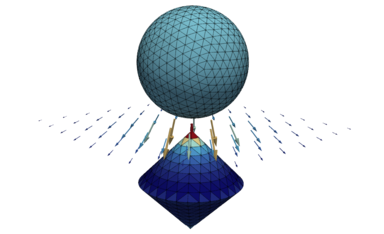
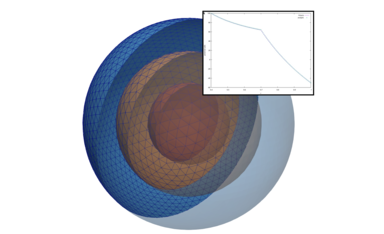
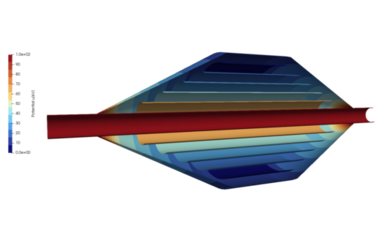
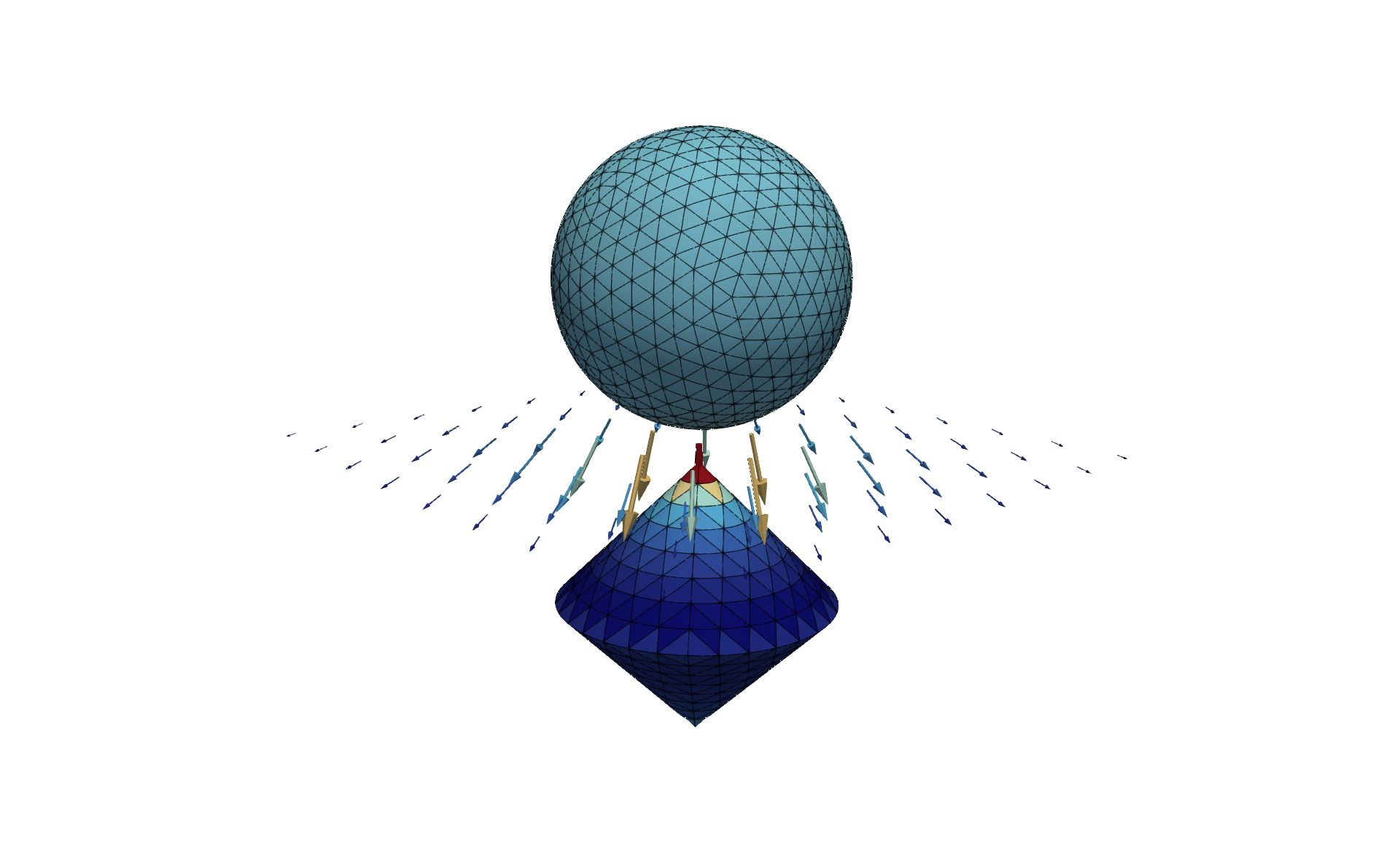
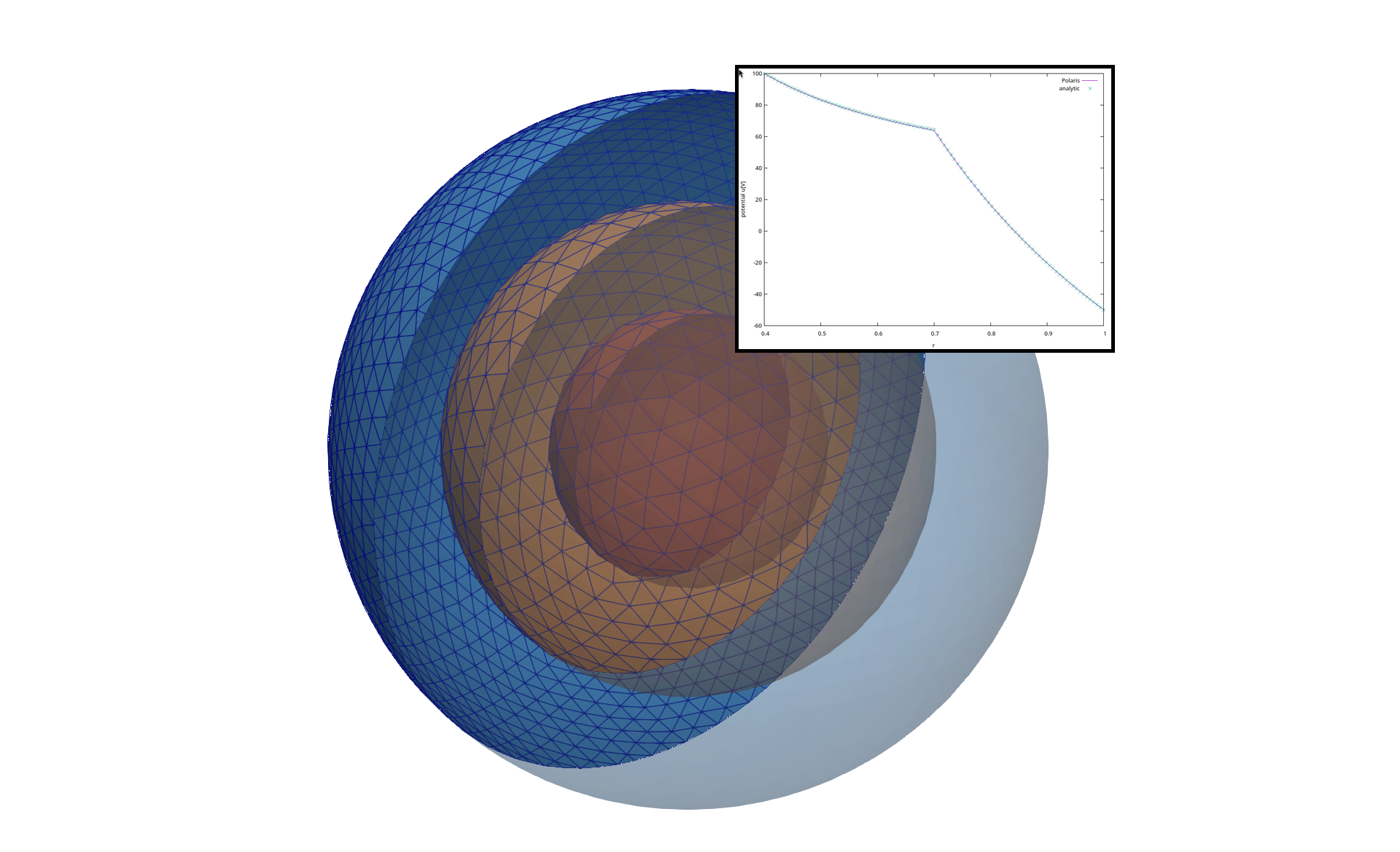
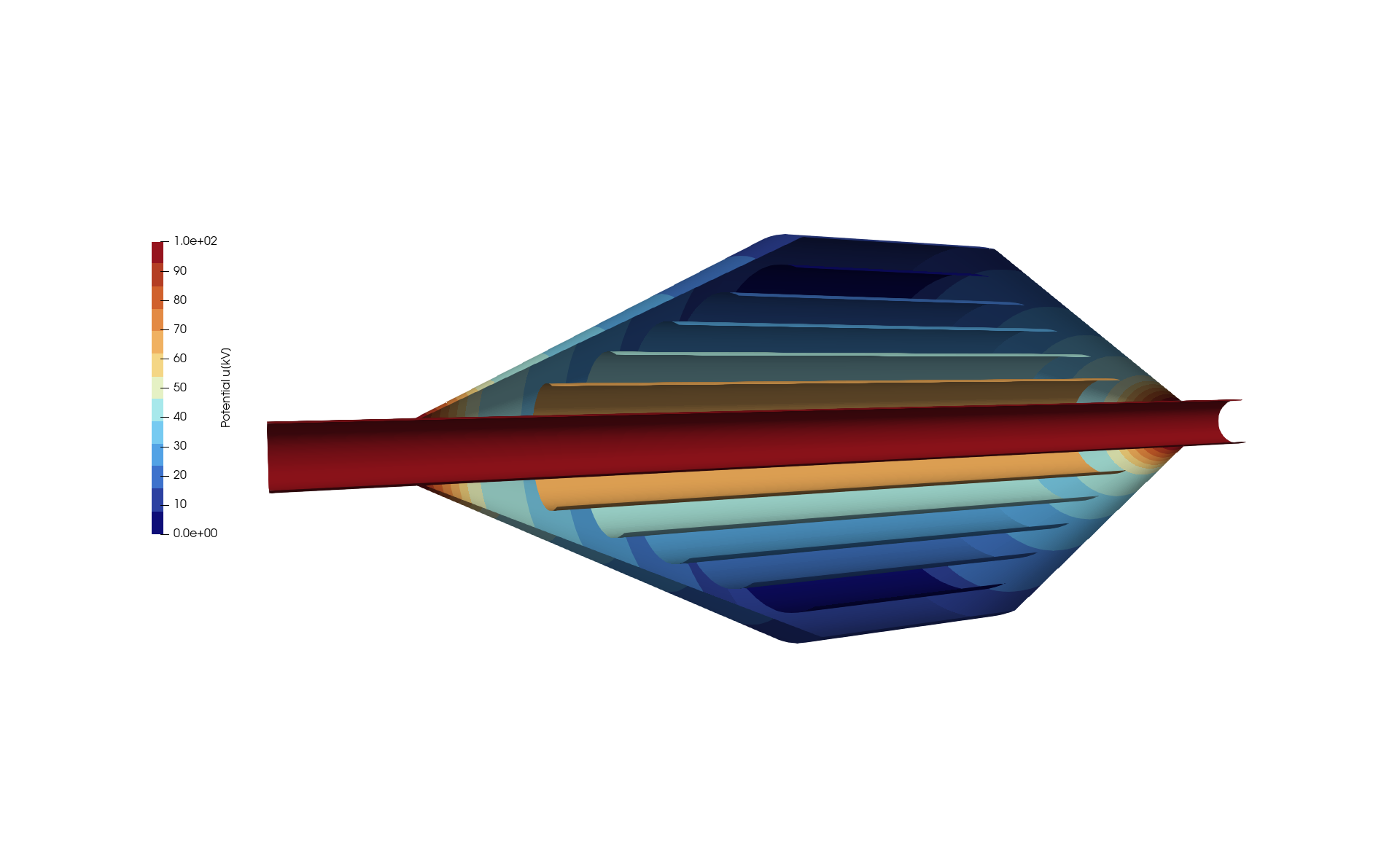
Here are some simple POLARIS examples. We gratefully acknowledge Elliptic Fields for providing some of the examples.
Features
- Processes GMSH and Nastran BDF surface mesh files
- Support for 1st and 2nd order triangular and quadrilateral elements
- Models electrodes, dielectric media, and floating/free potentials
- Calculates the electric field in the exterior domain
- Covers a wide range of hardware: Runs on Laptops as well as on HPC clusters
- POLARIS is based on a Galerkin BEM, and it utilizes Fast Multipole Methods as a compression technique
- The generated VTKHDF files can be visualized using ParaView
- The POLARIS preprocessor assists in the generation of the input data
- POLARIS is available for Linux and Windows 11. Linux builds support MPI and shared-memory parallelization; the Windows version supports shared-memory parallelization. For other operating systems, please contact us
- POLARIS is free for non-commercial use
Download
Latest version
The Linux builds are based on AlmaLinux 8.10 (Cerulean Leopard), but any Linux system with glibc ≥ 2.28 should work.
For detailed information
about the underlying MPI
implementation please
look
into manifest/release.json.
The Linux builds can be verified by using our public GPG key (Go to https://github.com/TAILSIT/gpg for further information). Verification can then be done via:
gpg --verify <polaris-gz>.sha256.asc <polaris-gz>.sha256sha256sum --check <polaris-gz>.sha256
Documentation
A detailed description about POLARIS can be found
in the
included README.md. In addition, the
contents of README.md
are also available via
the online
documentation.
Non-Commercial License
In order to obtain a valid license file for
non-commercial purposes, please fill
out this license form. This
license will be restricted to 16 MPI processes and
will be valid for 180 days. Once the license has
been received,
copy polaris_license.json
to the
location /any/location/you/like/polaris_license.json
and point to it with the environment
variable POLARIS_LICENSE_FILE. For
alternative ways, see the documentation. For commercial licenses of POLARIS,
please contact
us.
Quick start
After unzipping the archive (Linux) or installing (Windows),
the bin folder contains
the two
executables polaris
and polaris.post.
Run POLARIS simply via
[mpirun
                      -np <nproc>] polaris
                      -i <file.mesh> -s <settings.yaml>
share/examples
folder. Each example is accompanied with a
documentation and instructions of how
the settings.yaml file
can be obtained using
the preprocessor.
References
- Related project VEGA with publications here and there, Rhino3D plugin
- Poster presentation at IGTE Symposium 2026
About polaris
POLARIS is a high-performance simulation software for the dielectric design and analysis of high-voltage devices. It uses the Boundary Element Method (BEM) to accurately model electrostatic problems involving electrodes, dielectric media, and floating or initially unknown potentials.
Designed with scalability in mind, POLARIS uses MPI-based parallelization and runs efficiently across a wide range of hardware—from laptops and engineering workstations to large HPC clusters. A Fast Multipole Method (FMM) provides efficient compression of the boundary-element operator, avoiding the storage and computational cost of dense BEM matrices and enabling the simulation of large-scale models.
POLARIS accepts various surface mesh formats and supports both flat and curved triangular and quadrilateral surface elements. Higher-order discretizations based on L² and H¹ᐟ² finite-element spaces allow the accuracy of the numerical model to be adapted to the requirements of the application.
In addition to solving for surface quantities, POLARIS can evaluate the electric field throughout the exterior domain, providing the information required to analyze field distributions and identify critical regions in high-voltage designs.
Simulation results are written in the modern VTKHDF format and can be opened directly in visualization and post-processing software such as ParaView.
A complementary browser-based POLARIS application provides a graphical interface for creating and configuring simulation models. It simplifies the preparation of POLARIS input files and makes setting up dielectric simulations accessible without manually writing configuration data.