2026-09-25
This example for POLARIS is taken from [1].
|
|---|
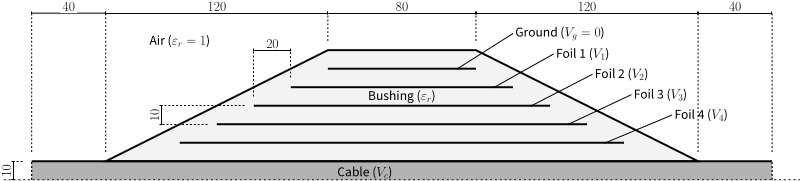
| Sketch of the bushing |
In order to see how to generate the bushing.yaml input
file with the preprocessor of POLARIS,
check the Preprocessor Tutorial.
The bushing is made of epoxy with \(\varepsilon_r=5\) and a cable and its extension are subject to a voltage of \(V_c=100\,kV\). Embedded into the dielectric (epoxy), there are 5 cylindrical foils: 4 of them are floating conductors with zero charge \(Q=0\,C\) and the outermost one is grounded \(V_g=0\,kV\).
With the command
polaris -i bushing.mesh -s bushing.yamlthe simulation is executed.
From the terminal output, one can extract the computed voltages on the interior foils (all in \(kV\))
#-------------------------------------------------------------------
# Floating potentials
#-------------------------------------------------------------------
# Name              Appl. charge      Voltage
  Sheet-1           +0.00000000E+00   +7.12055373E+01
  Sheet-2           +0.00000000E+00   +5.18854437E+01
  Sheet-3           +0.00000000E+00   +3.54547347E+01
  Sheet-4           +0.00000000E+00   +1.91691088E+01
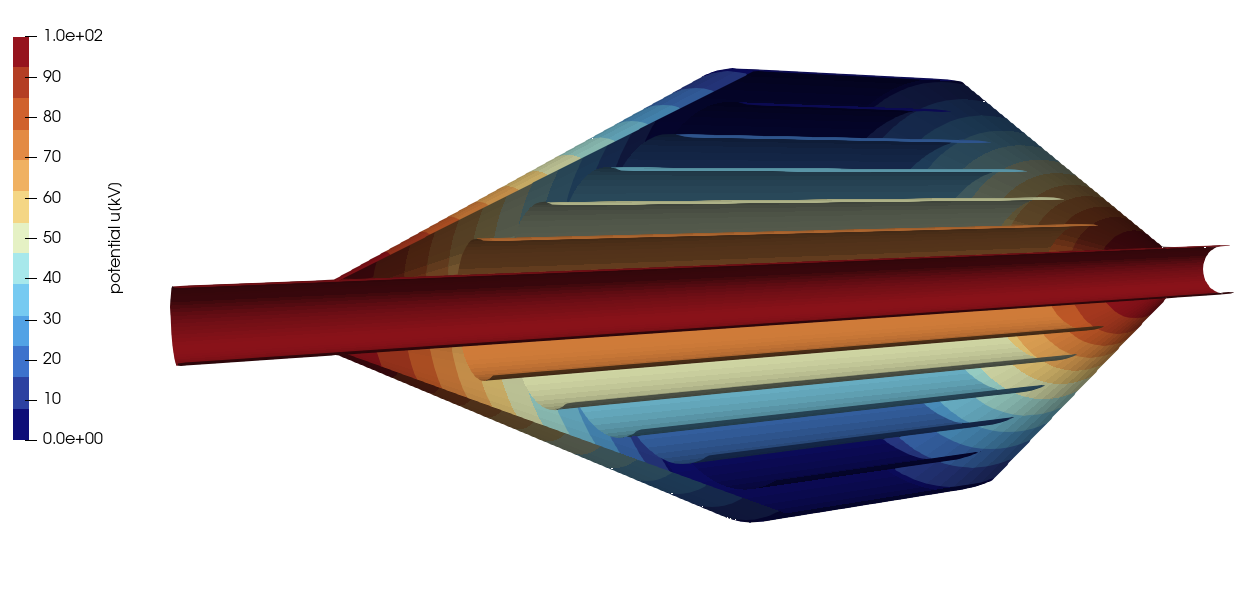
Note that, for a relatively coarse mesh, these results are in good agreement with the ones reported in [2].
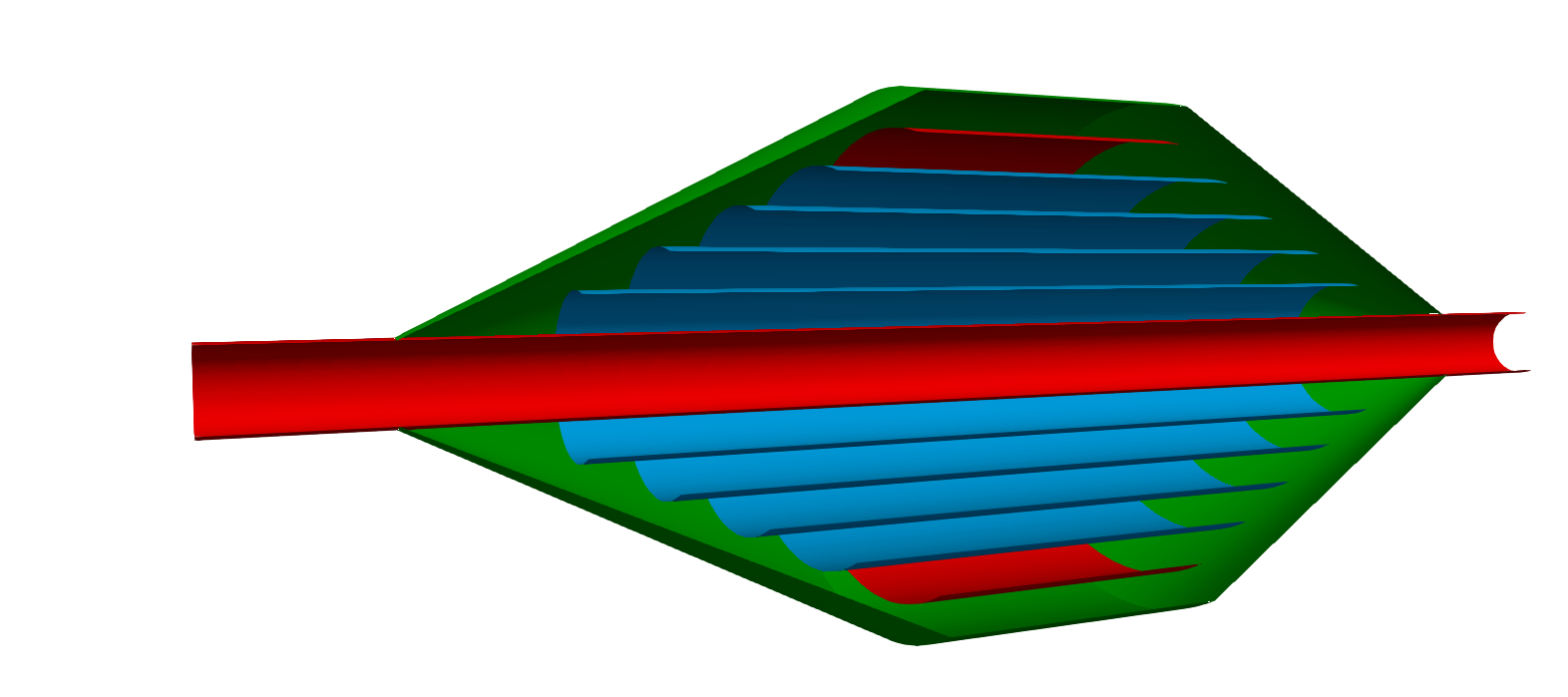
Below are screenshots from ParaView.
 |
|---|
| Bushing model |
 |
|---|
| Computed potential |
Andjelic, Z., Wohlmuth, M., Krstajic, B., Steinbigler, H., Milojkovic, S. & Blaszczyk, A. Integral methods for the calculation of electric fields: for application in high voltage engineering. Forschungszentrum Jülich GmbH Zentralbibliothek, Verlag, Scientific series of the International Bureau 10, I, 79 pp. (1992)
Münger, C., Börm, S. & Ostrowski, J. Dielectric breakdown prediction with GPU-accelerated BEM. In: Scientific Computing in Electrical Engineering: SCEE 2020, Eindhoven, The Netherlands, 137 pp. (2021), Arxiv.org